
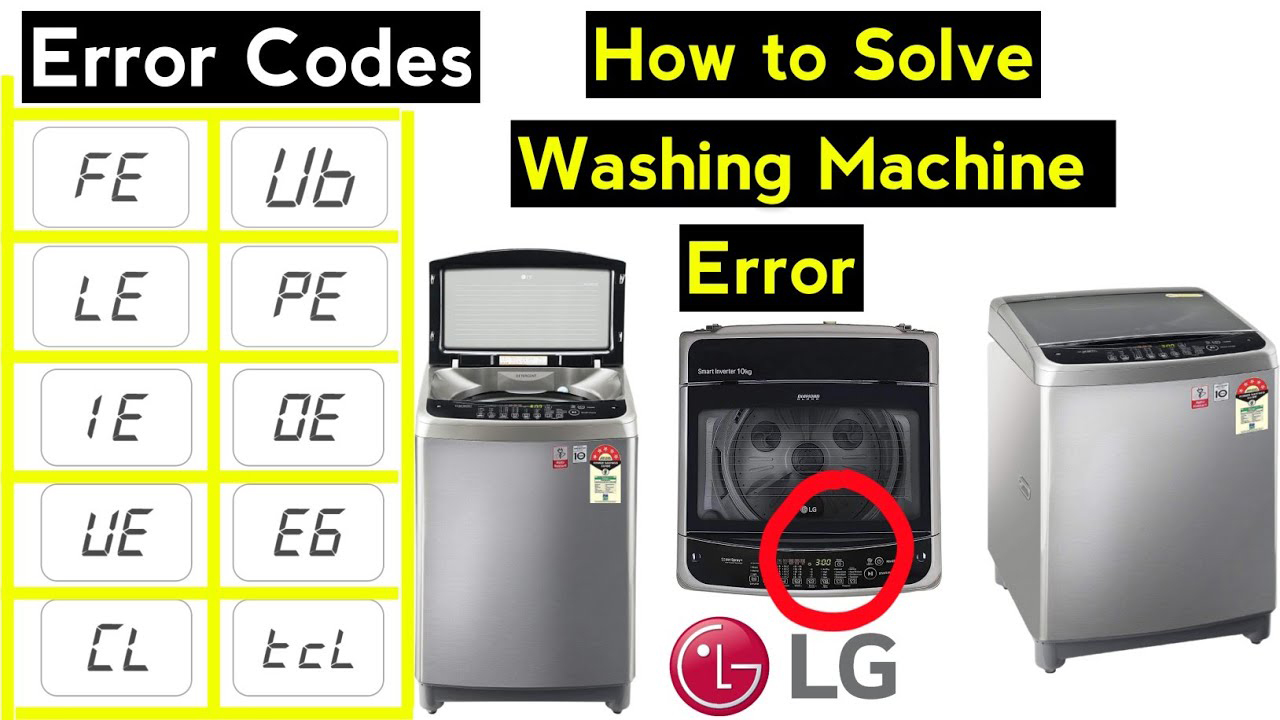
A Comprehensive List of All Universal Washing Machine Error Codes, Meanings and Solutions
If your washing machine has suddenly flashed a code at you instead of finishing the wash cycle, you’re not alone. Modern washing machines are built with self-diagnostic systems that display error codes the moment something goes wrong, whether it’s a blocked drain, a faulty sensor, or a door that hasn’t latched properly. The problem is that most manufacturers use their own numbering and lettering systems, which makes it confusing for the average homeowner to figure out what’s actually happening inside the machine.
This guide brings together the most common washing machine error codes across major brands sold in Kenya and internationally, including Samsung, LG, Bosch, Hisense, Ramtons, Nunix, Von, Whirlpool, and Mika. While every brand has its own naming convention, most error codes fall into a handful of universal categories: water inlet problems, drainage issues, door/lid faults, motor and sensor failures, heating element faults, and communication errors between the control board and other components.
Why Washing Machine Error Codes Matter
An error code is essentially the machine’s way of protecting itself. Instead of continuing to run a cycle when something isn’t right, the control board halts the process and displays a code so the fault can be identified quickly. Ignoring these codes or repeatedly resetting the machine without addressing the underlying issue often leads to bigger, more expensive repairs down the line, such as burnt-out motors or damaged control boards.
Understanding these codes also saves you money. Many callouts for washing machine repair turn out to be simple fixes, like clearing a blocked filter or repositioning a hose, that a technician can talk you through over the phone once the code is known. Others genuinely need a professional to open up the machine, test components with a multimeter, and replace faulty parts.
Get a technician to come and Check your Machine Now! Get those error code issues fixed, call +254746801984
The Complete Error Code Reference Table
| Code | Common On | What It Means | Likely Cause | Recommended Solution |
|---|---|---|---|---|
| E1 / LE | Samsung, LG, Hisense, Von | Water leakage detected inside the machine | Damaged door seal, cracked drum, loose hose connection | Inspect the door gasket and hose fittings; call a technician if leakage continues after tightening connections |
| E2 / OE | Samsung, LG, Bosch | Drain error, water not exiting the drum | Blocked drain filter, kinked drain hose, faulty drain pump | Clean the drain filter first; if the pump is not spinning, it may need replacement |
| E3 / dE | Samsung, LG, Ramtons | Door or lid not locked properly | Worn door latch, obstruction in the door seal, faulty door lock switch | Check for trapped clothing or debris around the door; replace the lock switch if the door still won’t latch |
| E4 / IE | Samsung, LG, Nunix | Water inlet error, machine not filling | Closed tap, blocked inlet filter, faulty inlet valve, low water pressure | Confirm the water supply is on and check inlet filter screens before assuming valve failure |
| E5 / HE | Samsung, LG, Mika | Heating fault, water not reaching set temperature | Burnt heating element, faulty thermistor, wiring fault | Element testing with a multimeter is required; most heating faults need part replacement |
| E6 / FE | Samsung, LG | Overheating or excessive heating detected | Faulty thermostat, control board fault | Requires professional diagnosis; do not continue running the machine |
| E7 / CE | Samsung, LG | Motor or current sensing error | Overloaded drum, worn carbon brushes, motor winding fault | Reduce load size and check for drum obstruction; motor brushes may need replacement |
| E8 | Samsung | Water level sensor (pressure switch) fault | Blocked or disconnected pressure hose, faulty sensor | Clean the pressure switch hose of debris or replace the sensor |
| E9 | Samsung | Draining fault combined with unbalanced load | Uneven load distribution, drain blockage | Redistribute the load and check drain pump function |
| UE / Ub | Samsung, LG | Unbalanced load detected | Heavy items bunched on one side, small loads of heavy fabrics like towels | Pause the cycle and redistribute clothing evenly around the drum |
| Ub / UB | LG, Hisense | Unbalance error during spin cycle | Uneven weight distribution, worn suspension springs | Rearrange laundry; inspect suspension rods if the fault repeats often |
| PE / PF | Samsung, LG | Power failure occurred mid-cycle | Power outage, tripped circuit breaker | Restart the cycle once power is stable; check the breaker if it trips repeatedly |
| tE / tS | LG | Temperature sensor fault | Faulty thermistor, loose wiring connector | Technician should test and replace the thermistor |
| CL | Samsung, LG | Child lock activated | Control panel locked accidentally | Hold the child lock button for 3-5 seconds to deactivate |
| F1 | Whirlpool, Bosch | Control board or main electronic fault | Power surge damage, board component failure | Requires control board inspection and possible replacement |
| F2 | Whirlpool, Bosch | Keypad or button fault | Sticky or stuck button, water damage to control panel | Clean around buttons; replace control panel if a button is physically damaged |
| F5 | Whirlpool | Door switch fault | Damaged door switch assembly | Replace the door switch |
| F7 | Whirlpool | Motor control fault | Faulty motor control unit, wiring fault | Requires professional motor and wiring inspection |
| F9 | Whirlpool | Long drain time detected | Slow-draining pump, partial blockage | Clean the pump filter and check the drain hose for kinks |
| SUD / Sud | Samsung, LG | Excess suds/foam detected | Using regular detergent instead of low-suds/HE detergent | Run a rinse-only cycle and switch to the correct detergent type |
| 5C / 5d | Samsung | Water drainage temperature or blockage related error | Prolonged draining, pump strain | Check filter and pump for obstruction |
| Ln / LC | Samsung | Foreign object or lint stuck in drum drainage | Coins, buttons, small fabric items lodged in pump | Remove and clean the pump filter housing carefully |
| AE / A.E | Bosch | General electronic component fault | Wiring fault, sensor malfunction | Needs component-level diagnosis by a technician |
| C1 / C2 | Bosch | Motor overload or speed sensor fault | Overloaded drum, worn motor bearings | Reduce load and inspect motor bearings |
| dOOr / door | Bosch, Von | Door open or not sensed as closed | Object blocking door sensor, worn hinge | Ensure nothing obstructs the door edge; inspect hinge alignment |
| E01–E09 | Hisense, Mika | Series of general sensor and communication faults | Wiring faults, sensor disconnection | Best diagnosed with a multimeter by a trained technician |
Breaking Down the Most Frequent Codes We See in Nairobi Homes
Out of all the codes listed above, a handful come up repeatedly during service calls. Drainage errors top the list, largely because of how laundry is typically loaded in many households, with socks, tissue, and small items slipping past the drum and lodging in the pump filter. This is usually the fastest fix on our call sheet, often resolved within 15 to 20 minutes once the filter housing is opened and cleared.
Door lock faults come in second. These are common in machines that are a few years old, where the door latch mechanism has simply worn from repeated use. A replacement latch is inexpensive and doesn’t require any electrical rewiring, so most of these repairs are completed on the same visit.
Water inlet errors are frequently linked to inconsistent water pressure, an issue that varies quite a bit depending on the estate or building’s plumbing setup. In some cases, the filter screen on the inlet hose has simply collected sediment over months of use and just needs a rinse.
Heating faults tend to be the most involved repairs since they require testing the heating element directly with a multimeter to rule out a wiring issue versus a genuinely burnt element. These repairs typically take longer and cost more because the element has to be removed from the drum housing.
When to Attempt a Fix Yourself and When to Call a Technician
Some of the codes above point to problems you can resolve without any tools: redistributing an unbalanced load, switching detergent to reduce suds, deactivating a child lock, or confirming the water tap is fully open. These take a few minutes and cost nothing.
Others, particularly anything involving the heating element, motor control board, or main electronic board, should not be attempted without proper testing equipment. Opening up these components without knowing exactly what you’re testing for can cause further damage or create a safety hazard, since these parts carry live current even when the machine is unplugged from certain capacitors.
As a general rule, if resetting the machine and checking the obvious things (door closed properly, water supply on, filter clean, load balanced) doesn’t clear the code, it’s worth getting a technician to run a proper diagnostic rather than repeating the reset multiple times.
A Quick Note on Universal vs Brand-Specific Codes
While this list groups codes by what they generally represent, it’s worth remembering that the exact letter or number shown can differ even between two models from the same manufacturer. A Samsung front-loader from 2018 might display “4E” for a water inlet fault, while a newer model shows “IE.” When in doubt, the machine’s manual (or a quick search using the model number printed inside the door or on the back panel) will confirm exactly what a specific code means for that unit.
If your machine displays a code not covered above, it’s usually still one of the six categories discussed here: leakage, drainage, door/lid, water inlet, heating, or motor/sensor faults. Identifying the category alone is often enough to know whether it’s a quick fix or one that needs a technician’s visit.