
Complete Guide to Washing Machine Error Codes by Fault Type and Brand
Washing machines from different manufacturers use digital error codes to alert users when a fault occurs. These codes help identify problems affecting water supply, drainage, door locks, drum movement, motors, heating systems, sensors and electronic controls.
Understanding these messages can make it easier to identify the source of a problem, carry out basic checks and determine when professional repair is necessary. However, washing machine error codes are not universal. A code such as E1 may indicate a water supply problem on one brand but a different fault on another.
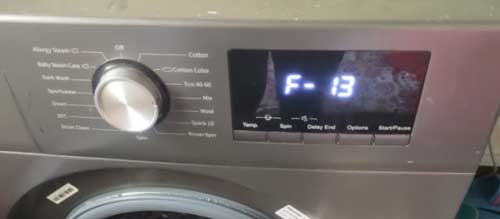
This guide groups commonly used washing machine error codes by fault type and manufacturer. It covers popular brands such as Samsung, LG, Bosch, Whirlpool, Electrolux, Hisense, Haier and Panasonic.
Important: Error codes can differ between washing machine models, production years and markets. Always compare the code with the manual for your exact model before attempting a repair. The tables below are a practical reference, not a substitute for manufacturer-specific diagnostic information.
1. Washing Machine Water Inlet and Water Supply Error Codes
Water inlet faults occur when a washing machine cannot receive enough water within the expected time. The cause may be a closed tap, low water pressure, blocked inlet filter, damaged hose or faulty water inlet valve.
These faults commonly prevent the machine from starting a wash cycle or cause it to stop while filling.
| Brand | Common error codes | Meaning |
|---|---|---|
| Samsung | 4C, 4E, E1 | Water is not being supplied properly |
| LG | IE | Water inlet or filling problem |
| Bosch | E17, F17, F29 | Water supply is too slow or insufficient |
| Whirlpool | F8 E1, FH, LO FL | Low water flow or water supply problem |
| Electrolux | E10, E11 | Water inlet or filling problem |
| Hisense | F01 | Water inflow fault |
| Haier | E4 | Water supply problem on specified models |
| Panasonic | U14 | Water cannot be supplied properly |
Common causes of water inlet errors
- Water supply tap is closed or partially closed.
- Water pressure is too low.
- Inlet hose is bent, twisted or blocked.
- Small mesh filters inside the inlet connection are clogged.
- Water inlet valve is defective.
- Electrical connection to the inlet valve is faulty.
- Water supply has been interrupted.
Recommended checks
- Confirm that the water tap is fully open.
- Check whether water is flowing normally from the supply point.
- Inspect the inlet hose for bends or damage.
- Turn off the water supply and inspect accessible inlet filters.
- Restart the machine after correcting any obvious supply problem.
- Contact a technician if the error continues.
Useful information: A water inlet error does not automatically mean the inlet valve is defective. Low water pressure, blocked filters and incorrectly installed hoses can produce similar symptoms.
Samsung identifies 4C, 4E and E1 as water supply messages, while LG uses IE for an inlet error. Bosch groups E17 and F17 with water connection problems. https://www.samsung.com/africa_en/support/home-appliances/check-out-the-information-codes-on-my-washing-machine/ https://www.lg.com/africa/support/product-help/CT20080042-20152500935884 https://www.bosch-home.com/us/en/c/spotlight/blt341dacb48f00c362/owner-support/error-codes/washers
2. Washing Machine Drainage and Water Outlet Error Codes
Drainage errors occur when a washing machine cannot remove water within the expected time. The machine may stop with water remaining inside the drum, fail to enter the spin cycle or display an error before completing the programme.
| Brand | Common error codes | Meaning |
|---|---|---|
| Samsung | 5C, 5E, SC, nd | Water is not draining properly |
| LG | OE, E03, E21 | Water outlet or drainage problem |
| Bosch | E18, F18 | Drainage time exceeded or drain hose blocked |
| Whirlpool | F9 E1, F21 | Long drainage time or drainage system fault |
| Electrolux | E20, E21 | Drainage problem |
| Hisense | F03 | Drainage fault |
| Haier | E1 | Drainage problem on specified top-load models |
| Panasonic | U11 | Water cannot drain |
Common causes of drainage errors
- Blocked drain pump filter.
- Drain hose is twisted or obstructed.
- Foreign objects inside the pump.
- Defective drain pump.
- Incorrect drain hose installation.
- Blocked household drainage connection.
- Electrical or control problems affecting the pump.
What to check when a drainage code appears
- Check the drain hose for bends and visible blockages.
- Inspect the pump filter if the model has an accessible filter.
- Remove lint, coins and other foreign objects from the filter.
- Check whether the household drain is blocked.
- Confirm that the drain hose is installed according to the manufacturer’s instructions.
Some front-loading machines have a small emergency drain hose near the pump filter. Use it according to the appliance manual when removing trapped water.
Do not open a pump filter while the machine contains hot water without taking appropriate precautions. Disconnect the appliance from power before inspecting accessible components.
Repair tip: A machine that fills normally but refuses to empty may have a blocked filter, restricted drain hose or defective pump. A technician should test the pump and its electrical supply before recommending replacement.
Samsung lists 5C and 5E as drainage errors. LG uses OE, while Bosch identifies E18 and F18 with drainage problems. Whirlpool uses codes including F9 E1 for extended drain times. https://www.samsung.com/africa_en/support/home-appliances/check-out-the-information-codes-on-my-washing-machine/ https://www.lg.com/ae/support/product-help/CT20076046-20155069433020 https://producthelp.whirlpool.com/Laundry/Washers/Product_Info/Washer_Product_Assistance/Error_Codes_in_Front_Load_Washers
3. Door Lock, Door Open and Lid Error Codes
Modern washing machines have safety mechanisms that prevent operation when the door or lid is not properly closed. A door lock error can stop a cycle from starting or prevent the door from unlocking after washing.
| Brand | Common error codes | Meaning |
|---|---|---|
| Samsung | dC, dE, dC1, dE1, dC3, dE3 | Door or Add Door locking problem |
| LG | dE, dE1, dE2, dE4, dL | Door open or door locking problem |
| Bosch | E16, F16 | Door is open |
| Whirlpool | F5 E2, FdL | Door lock or latch problem on applicable models |
| Electrolux | E40, E41 | Door locking problem |
| Hisense | F13, F14 | Door locking or unlocking fault |
| Haier | E2 | Top lid is not closed on specified top-load models |
| Panasonic | U12 | Lid is open |
Common causes
- Door has not been closed properly.
- Clothing is trapped between the door and rubber seal.
- Door latch is damaged.
- Door lock assembly is defective.
- Wiring to the lock is loose or damaged.
- Control board is not detecting the lock signal.
Possible solutions
- Open the door and remove clothing trapped around the seal.
- Close the door firmly without forcing it.
- Check for visible damage around the latch.
- Restart the washing programme.
- If the door remains locked or the code returns, arrange professional inspection.
Do not force open a locked washing machine door. This can damage the handle, latch or door assembly and may cause water to spill.
Safety note: The door lock is an important electrical and mechanical safety component. Replacing or bypassing it without proper testing can create a risk of electric shock, water leakage or unsafe operation.
4. Unbalanced Load and Spin Cycle Error Codes
A washing machine may refuse to spin when clothes are unevenly distributed inside the drum. The appliance detects excessive movement and may pause the programme to prevent damage.
This is common when washing heavy blankets, towels, single bulky garments or very small loads.
| Brand | Common error codes | Meaning |
|---|---|---|
| Samsung | Ub, UE, Ur | Unbalanced load or spin difficulty |
| LG | UE | Unbalanced load |
| Bosch | E32 | Load imbalance or spin-related condition on specified models |
| Hisense | Unb | Unbalanced load |
| Panasonic | U13, U17 | Unable to spin or spin-related problem on specified models |
| Whirlpool | F0 E3 | Load-related condition on applicable models |
Common reasons for an unbalanced load
- Washing one heavy item on its own.
- Overloading the drum.
- Mixing heavy and very light clothing.
- Machine is not level.
- Clothes have become tangled.
- Worn suspension components or shock absorbers.
What to do
- Pause the washing cycle.
- Redistribute clothing evenly around the drum.
- Remove some items if the drum is overloaded.
- Add a few suitable items if the load is too small and the manual recommends doing so.
- Check that the machine stands on a firm, level surface.
- Run a spin-only programme.
If the washing machine repeatedly shakes violently even with a balanced load, a technician should inspect the suspension, shock absorbers, springs, bearings and drum support.
5. Motor, Drum Rotation and Drive System Error Codes
Motor-related errors occur when the washing machine cannot rotate the drum correctly or when its electronic controls detect a problem with motor operation.
The fault may involve the motor, wiring, drive belt, motor sensor, inverter or electronic control board.
| Brand | Common error codes | Meaning |
|---|---|---|
| Samsung | 3C, 3E, 3E1, 3E2, 3E3, 3E4 | Motor problem |
| LG | LE, LE1, AE | Motor or rotation-related problem; meaning varies by model |
| Bosch | E21, F21, F42, F43, F44 | Motor or drive system fault |
| Whirlpool | F7 E1 | Motor speed sensing error |
| Electrolux | E50 series | Motor-related fault |
| Hisense | Model-dependent electronic or motor fault codes | Motor or electronic system may require diagnosis |
| Beko | H6, H11 | Motor triac or motor/tachometer circuit fault on specified models |
Symptoms of motor and drum faults
- Drum does not rotate during washing.
- Machine fills with water but does not agitate.
- Drum stops unexpectedly.
- Machine makes unusual mechanical noises.
- Spin cycle does not reach the expected speed.
- Motor overheats or trips electrical protection.
Possible causes
- Worn motor brushes on applicable motor designs.
- Damaged drive belt.
- Defective motor sensor or tachometer.
- Loose motor wiring.
- Jammed drum or trapped foreign object.
- Faulty inverter or motor control board.
- Worn bearings or mechanical resistance.
A motor error code does not always mean the motor itself needs replacement. The technician should inspect the drive system and test the electrical components before deciding on the repair.
Important: Avoid repeatedly restarting a machine that produces a motor error accompanied by burning smells, overheating or loud mechanical noises. Continued operation can worsen the damage.
LG identifies LE and LE1 with motor-related rotation problems on certain models, while Samsung uses several 3C and 3E variations for motor faults. Whirlpool uses F7 E1 for motor speed sensing problems. https://www.lg.com/us/support/help-library/lg-top-load-washer-error-code-list–20154403824105 https://www.samsung.com/uk/support/home-appliances/what-do-the-codes-on-my-washing-machine-mean/ https://producthelp.whirlpool.com/Laundry/Washers/Product_Info/Washer_Product_Assistance/Error_Codes_in_Front_Load_Washers
6. Water Overflow, Leakage and Excessive Foam Error Codes
Overflow and leakage errors indicate that the machine has detected too much water, possible water leakage or excessive foam.
These faults should be taken seriously because water can damage the floor, nearby electrical fittings and the washing machine itself.
| Brand | Common error codes | Meaning |
|---|---|---|
| Samsung | OC, OE, OF, 1OC | Water overflow |
| LG | FE, AE | Overflow or leakage-related fault, depending on model |
| Bosch | E23, F23 | AquaStop or water protection system activated |
| Electrolux | EF0 | May indicate leakage, excess foam or load-related condition |
| Hisense | F24 | Water has reached overflow level |
| Haier | F2 | Water has reached a critical level on specified models |
| Whirlpool | F8 E3 | Overfill condition on applicable models |
Common causes
- Faulty water inlet valve.
- Defective water level or pressure sensor.
- Damaged internal water hose.
- Excessive detergent use.
- Blocked pressure chamber or pressure tube.
- Leaking pump or hose connection.
- Faulty electronic control.
What to do when an overflow code appears
- Stop the washing programme.
- Turn off the water supply tap.
- Disconnect power if it is safe to do so and there is no standing water around the electrical connection.
- Avoid using the appliance until the cause has been identified.
- Arrange professional inspection if water continues entering or leaking from the machine.
Safety warning: If water is leaking near the plug, socket or electrical wiring, do not touch wet electrical fittings. Isolate power from a safe location and seek qualified assistance.
7. Heating Element and Temperature Sensor Error Codes
Some washing machines heat water to a selected temperature during the wash cycle. A heating error may occur when the appliance cannot reach the required temperature or detects an abnormal temperature reading.
| Brand | Common error codes | Meaning |
|---|---|---|
| Samsung | tE, HE, HC | Temperature sensor or heating system fault |
| LG | tE, HE | Temperature sensor or heating-related problem, depending on model |
| Bosch | E19, F19 | Heating time exceeded |
| Bosch | E20, F20 | Unexpected heating condition |
| Electrolux | E60 series | Heating system problem |
| Beko | H1, H2, H3 | Temperature sensor or heating circuit faults |
Common causes
- Defective heating element.
- Faulty thermistor or temperature sensor.
- Damaged wiring.
- Limescale deposits on the heating element.
- Faulty heater relay or control board.
- Poor electrical connection.
Possible symptoms
- Clothes are not washed at the expected temperature.
- Washing cycles take longer than usual.
- Machine stops before completing the programme.
- Error appears during a hot wash.
- Machine repeatedly reports a temperature-related fault.
Heating components involve electrical testing and may operate at high temperatures. A qualified technician should test the heater, temperature sensor and control circuit before replacing parts.
8. Water Level and Pressure Sensor Error Codes
The pressure sensor monitors the amount of water inside the washing machine. It helps the control system determine when to stop filling and when to proceed with the next stage of a wash cycle.
| Brand | Common error codes | Meaning |
|---|---|---|
| Samsung | 1C, 1E | Water level sensor issue |
| LG | PE | Pressure sensor error |
| Electrolux | E30 series | Water pressure or pressure sensing problem |
| Bosch | E26, F26, F27 | Analogue pressure sensor or pressure sensing fault |
| Beko | H7 | Pressure sensor failure |
Common causes
- Defective pressure sensor.
- Blocked pressure tube.
- Damaged wiring.
- Air leaks in the pressure hose.
- Blocked pressure chamber.
- Control board malfunction.
Recommended checks
- Inspect the accessible pressure hose for visible damage.
- Check for loose connections.
- Have the pressure sensor tested using appropriate diagnostic equipment.
- Inspect the pressure chamber and control circuit if necessary.
A faulty pressure sensor can cause several symptoms, including overfilling, underfilling, failure to start or unexpected programme interruptions.
9. Electronic Control Board and Communication Error Codes
Electronic control boards coordinate the operation of the washing machine. They control the motor, water valves, pump, heating system, sensors and display panel.
When communication between electronic components fails, the machine may stop working or display a control-related error.
| Brand | Common error codes | Meaning |
|---|---|---|
| Samsung | AC, AE, 3CP | Communication or electronic control issue |
| LG | CE | Electrical or motor overcurrent-related fault on applicable models |
| Bosch | E56, F56 | Communication or electronic system fault on specified models |
| Whirlpool | F6 E1, F6 E2, F28 | Communication or control system faults |
| Haier | FC2 | Communication failure between display and power boards |
| Hisense | F04–F07, F23 | Electronic module fault on specified models |
Possible causes
- Power fluctuations.
- Damaged control board.
- Loose electrical connections.
- Moisture or corrosion on circuit boards.
- Defective motor control module.
- Communication failure between electronic components.
What should be done?
- Record the complete error code.
- Switch off the appliance using its normal power control.
- Disconnect it from power only if it is safe to do so.
- Allow a short period before restarting, following the manufacturer’s guidance.
- If the code returns, arrange a professional diagnosis.
Control board replacement should not be the first response to every electronic error. A technician should check the wiring, power supply and connected components before recommending a new board.
10. Power Supply, Freezing and Other Special Error Codes
Some washing machine error codes do not fall neatly into the categories above. They may relate to power interruptions, freezing conditions, drying functions, cleaning reminders or smart connectivity.
| Brand | Code | Meaning |
|---|---|---|
| Samsung | PF | Power failure |
| Samsung | SUD | Excessive foam or suds detected |
| Samsung | 4C2, 4E2 | Water temperature or hot/cold connection issue on applicable models |
| LG | PF | Power failure |
| LG | FF | Freezing failure |
| LG | dHE | Drying system error on washer-dryer models |
| LG | CL | Child or control lock indication |
| LG | tCL | Tub-clean reminder |
| Electrolux | EH0 | Power supply problem |
| Electrolux | EF0 | Leakage, excessive foam or related condition |
| Panasonic | U81–U84 | Network or smart connectivity errors on specified models |
Some displays are not fault codes. For example, CL may simply mean that the child lock is active, while tCL can be a reminder to clean the washing machine drum.
A special code should therefore be interpreted using the manual rather than assuming that every display message indicates a damaged component.
11. Quick Reference: Washing Machine Error Codes Grouped by Fault Type
The following table brings together the main code families covered in this guide. It is useful when comparing error messages across different washing machine brands.
| Fault type | Samsung | LG | Bosch | Whirlpool | Electrolux | Hisense / Haier / Panasonic |
|---|---|---|---|---|---|---|
| Water inlet | 4C, 4E, E1 | IE | E17, F17 | F8 E1, FH | E10, E11 | F01, E4, U14 |
| Drainage | 5C, 5E | OE, E03, E21 | E18, F18 | F9 E1, F21 | E20, E21 | F03, E1, U11 |
| Door lock | dC, dE | dE, dL | E16, F16 | F5 E2, FdL | E40, E41 | F13, F14, E2, U12 |
| Unbalanced load | Ub, UE | UE | E32 | F0 E3 | Model dependent | Unb, E3, U13 |
| Motor and rotation | 3C, 3E | LE, LE1 | E21, F21 | F7 E1 | E50 series | Model dependent |
| Overflow and leakage | OC, OE, OF | FE, AE | E23, F23 | F8 E3 | EF0 | F24, F2 |
| Heating and temperature | tE, HE, HC | tE, HE | E19, E20 | Model dependent | E60 series | Model dependent |
| Water level sensor | 1C, 1E | PE | E26, F26, F27 | Model dependent | E30 series | FA, model dependent |
| Electronic control | AC, AE, 3CP | CE | E56, F56 | F6 E1, F6 E2, F28 | Model dependent | FC2, F04–F07 |
Note: This comparison combines codes from different model families. It is not a universal compatibility chart. In particular, some codes listed under a brand are limited to particular front-load, top-load or washer-dryer models.
12. Washing Machine Error Codes by Brand: What to Know
Samsung washing machines
Samsung uses a combination of letters and numbers to identify faults. Common examples include:
- 4C and 4E for water supply.
- 5C and 5E for drainage.
- dC and dE for door problems.
- Ub and UE for unbalanced loads.
- 3C and 3E for motor problems.
- OC and OE for overflow.
- AC and AE for communication faults.
Samsung advises users to check the model-specific manual when a code is not listed in its general support information. https://www.samsung.com/africa_en/support/home-appliances/check-out-the-information-codes-on-my-washing-machine/
LG washing machines
LG uses codes such as IE, OE, UE, dE, LE, PE and FE. These messages help identify faults involving water supply, drainage, load balance, door locking, motor operation, water levels and overflow.
Some LG washer-dryer models also display drying-related messages such as dHE. The precise meaning should be checked against the appliance model. https://www.lg.com/africa/support/product-help/CT20080042-20152500935884
Bosch washing machines
Bosch commonly uses E-series and F-series codes. Examples include E16 for an open door, E17 for a water supply problem, E18 for a drainage problem, E19 for a heating time issue and E23 for the AquaStop protection system.
Bosch publishes model-specific troubleshooting information for its washing machines. https://www.bosch-home.com/us/en/c/spotlight/blt341dacb48f00c362/owner-support/error-codes/washers
Whirlpool washing machines
Whirlpool uses combinations such as F8 E1, F9 E1 and F7 E1. These can identify water supply, drainage and motor speed sensing problems. The company also maintains separate code lists for different washer types. https://producthelp.whirlpool.com/Laundry/Washers/Product_Info/Washer_Product_Assistance/Error_Codes_in_Front_Load_Washers
Electrolux washing machines
Electrolux groups many faults into code families:
- E10: water supply.
- E20: drainage.
- E30: water pressure sensing.
- E40: door lock.
- E50: motor.
- E60: heating.
- EF0: leakage, excess foam or related condition.
- EH0: power supply.
The exact suffix and recommended checks can vary by model. https://support.electrolux.co.uk/support-articles/article/electrolux-washing-machine-displays-an-error-code-causes-and-solutions
Hisense washing machines
Hisense models may use codes such as F01 for water inflow, F03 for drainage, F13 and F14 for door locking, F24 for overflow and Unb for an unbalanced load. Some models also use F04–F07 or other codes for electronic module faults.
Always consult the manual supplied with the particular Hisense model. https://dtc-aus-api.hisense.com/medias/HWFS1214PB-UM.pdf
Haier washing machines
Haier top-load models may use E1 for drainage, E2 for an open lid, E3 for an unbalanced load and E4 for water supply. Other codes, including FA and FC2, can indicate sensor or communication problems.
These meanings are model-dependent and should not automatically be applied to every Haier washer. https://www.haier.com/in/service-support/self-service/20240828_249143.shtml
Panasonic washing machines
Panasonic models may use U-series messages. Common examples include U11 for drainage, U12 for an open lid, U13 for an unbalanced load and U14 for a water supply problem. Certain newer connected models also use U81–U84 for network-related faults. https://www.panasonic.com/sg/consumer/washing-machine-learn/connectivity/smartapp/iot-wm/fr1-fc1-error-display.html
13. When Should You Call a Washing Machine Repair Technician?
Some error codes can be resolved by correcting a simple operating condition. Others require electrical testing, component inspection or replacement.
Consider professional repair when:
- The same error code returns after basic checks.
- The machine repeatedly stops before completing a wash.
- Water continues entering the machine when it is switched off.
- Water leaks from underneath the appliance.
- The drum does not rotate or makes grinding noises.
- The machine produces a burning smell.
- The door remains locked after the programme ends.
- The machine repeatedly trips the power supply.
- The display shows a motor, heating or electronic control fault.
A qualified technician can inspect the washing machine, test the affected components and determine whether the fault can be repaired without replacing an entire assembly.
14. Information to Provide When Booking a Washing Machine Repair
Providing accurate information helps a repair technician prepare for the visit and identify possible causes before arriving.
Have the following details ready:
- Brand: Samsung, LG, Bosch, Whirlpool, Hisense, Haier or another manufacturer.
- Model number: Usually printed on a label around the door opening, rear panel or side of the machine.
- Error code: Record the complete code, including letters, numbers and spaces.
- Symptoms: Explain whether the machine is not filling, draining, spinning, heating or unlocking.
- When the error occurs: For example, during filling, washing, rinsing or spinning.
- Recent changes: Mention recent installation, plumbing work, power interruptions or movement of the appliance.
A photograph of the display can also help the technician identify the exact message.
15. Frequently Asked Questions About Washing Machine Error Codes
1. Are washing machine error codes the same for all brands?
No. Manufacturers use different diagnostic systems. Even two washing machines from the same manufacturer may display different codes depending on the model and production year.
2. What does error code 4C mean on a Samsung washing machine?
Samsung 4C usually indicates a water supply problem. Check the water tap, inlet hose, water pressure and mesh filter. If the code remains, the inlet valve or another component may require inspection.
3. What does OE mean on an LG washing machine?
OE generally indicates a water outlet or drainage problem. Check the drain hose and pump filter for blockages. If the machine still cannot drain, the pump and drainage system may need testing.
4. What does E18 mean on a Bosch washing machine?
E18 or F18 commonly indicates a drainage problem. The drain hose may be kinked or blocked, or the pump filter may need cleaning.
5. What does UE mean on a washing machine?
UE commonly indicates an unbalanced load on Samsung and LG machines. Redistribute the laundry, check the machine’s level and run the spin programme again.
6. Can I reset a washing machine error code?
Some temporary messages can clear after following the manufacturer’s reset instructions. However, resetting does not repair the underlying fault. If the same code returns, further diagnosis is necessary.
7. Does an error code always mean a component is damaged?
No. Some codes are triggered by operating conditions such as low water pressure, an open door, an unbalanced load or excessive detergent. Others indicate component or electronic faults.
8. Can I continue using my washing machine when an error code appears?
It depends on the code. A simple imbalance message may only require redistributing clothes. However, stop using the appliance if there is a water leak, electrical fault, burning smell, overheating or suspected motor damage.
9. Why does my washing machine show an error code even when it looks normal?
The machine’s sensors may detect a problem that is not immediately visible. For example, a pressure sensor can detect an abnormal water level, while a motor sensor can detect a rotation problem.
10. Where can I find the correct error code for my washing machine?
Check the user manual, manufacturer’s support website or model-specific service documentation. The model number is important because code meanings can differ across appliance versions.
Conclusion
Washing machine error codes provide useful information about faults affecting the water supply, drainage, door lock, motor, heating system, sensors and electronic controls. Learning how these codes are grouped makes it easier to understand why a machine has stopped working and what should be checked first.
The most important step is to identify the appliance brand and exact model before interpreting a code. A Samsung 4C error, an LG IE error and a Bosch E17 error may point to a similar water supply problem, but their diagnostic procedures are not necessarily identical.
Simple problems such as a blocked filter, closed water tap or uneven load may be resolved through basic checks. Persistent errors, electrical faults, water leaks and motor problems should be assessed by a qualified washing machine repair technician.